AI hallucinations, often produced by generative AI chatbots, are when AI provides false or nonexistent information. This can be caused by a few different things including: overfitting (AI learns the training too precisely), underfitting (AI is too simplistic), and the way the prompts have been engineered.
The assumption that AI is always correct is a relatively fair judgement to make because, why would it confidently provide false information disguised as fact? Hallucinations can appear as simply a false piece of information and escalate into AI concocting entire websites/sources that don’t exist.
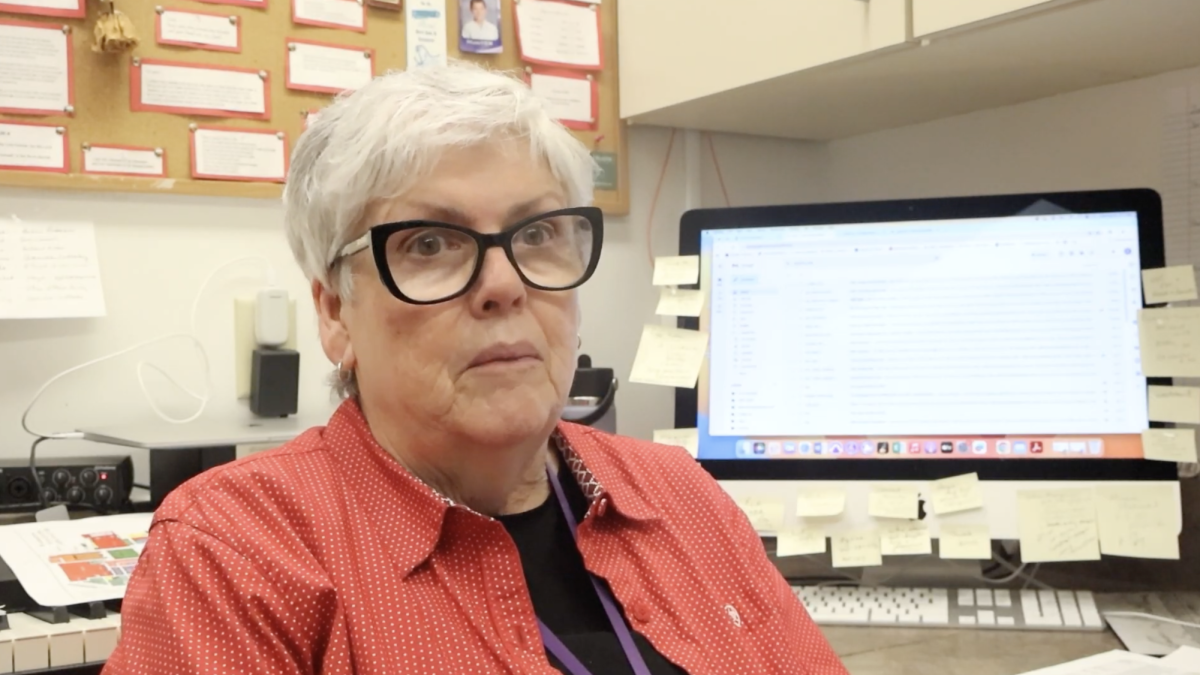
English teacher Jody Rowan is a major advocate against generative AI use in schools and in the real world.
“I think the biggest issue with AI is that students are using it instead of learning,” Rowan said. “You have to have skills that go beyond what AI can do in order to be worth hiring, even if you’re using AI, you have to be able to supervise it and improve on its work, because AI’s work isn’t perfect.”
The addition of AI hallucinations only amplifies the issue further. As an example Rowan used the prompt of “What is the best haircut?”
“And there’s a million articles about haircuts on the internet, then it can make a relatively good prediction in terms of content and as well as words,” Rowan said. “But when there’s no information about the thing, the content that you’re asking about, then it’s not going to make a very good prediction.”
For Rowan, when a student uses AI on a piece of writing or worksheet, it’s pretty obvious for a few reasons.
“When I read a student’s writing and I think that it’s AI, and that can be because of an AI detector, or just because it doesn’t sound like them,” Rowan said. “One of the first things I do is check their sources, because AI falsifies sources and citations.”
With the advancement of AI, it has migrated its way into schools. Teachers have to come up with creative ways to ensure that students aren’t cheating by using AI on assignments.
“I think we need to be doing a lot of work in class when we’re supervising to make sure AI isn’t being used,” Rowan said. “We’ve cut back a ton on the iPad use and we’re moving a lot more towards paper and pencil use.”
Teachers aren’t the only ones who have concerns on the effects of AI overuse. Junior Brooklyn Mickells has concerns about her peers’ futures.
“Sometimes students probably will have questions that [AI] can’t answer, and they won’t know that, because they’re just relying fully on this to do their work for them, and they won’t know that it’s all wrong,” Mickells said.
Mickells agrees that the addition of AI hallucinations only expands future issues.
“If it’s just making up stuff, and they don’t know that the information that they’re being told is false and they don’t know how to tell that from the truth, then it’s definitely gonna be bad,” Mickells said.
Rowan and Mickells alike believe that it’s important for students to have a full grasp on what heavy AI use does to their future and to fully understand the risks.
“I worry a lot that the job market that my kids face is going to be a lot harder than the job market that I faced, and you need to be preparing for that,” Rowan said. “You’ve got a whole life ahead of you that you need to be able to, you know, be employable.”